The Leonardi Letter
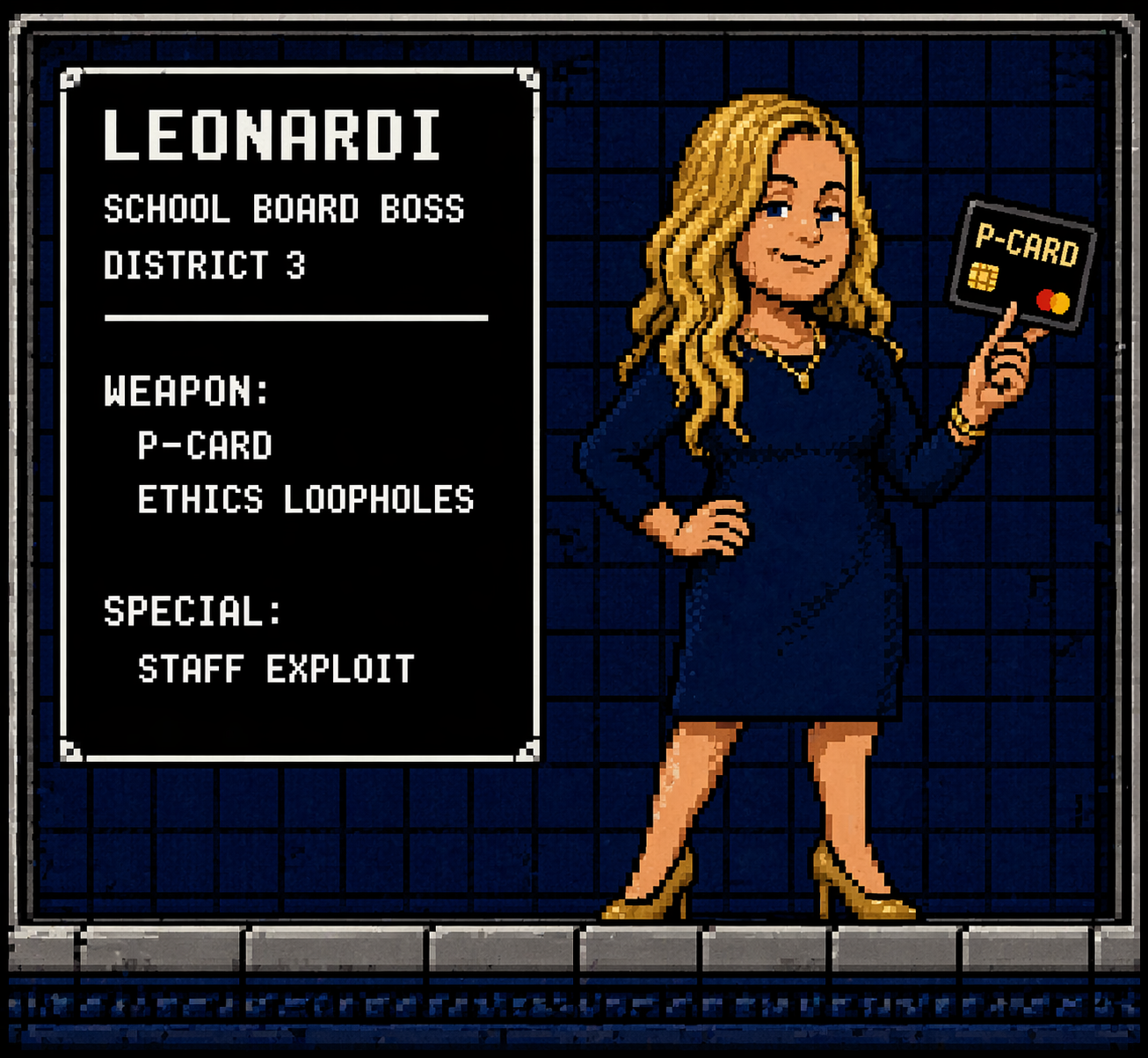
Her own letter does the damage.
In an undated written statement of facts released this week, Broward County School Board Chair Sarah Leonardi lays out exactly how a partisan political ad was bought using government resources.
She writes that on March 2nd, her executive secretary was asked by another executive secretary to gauge the board's interest in sponsoring an ad for a Broward Democratic Party gala.
Stop there.
“Gauge the board's interest.”
That sounds like a headcount. We will call it what it is: a poll of board members.
Read the statement straight through and it feels like that kind of office-to-office polling through staff is a regular thing over at the “Crystal Palace” School Board HQ.
FLORIDA'S SUNSHINE LAW ISN'T COMPLICATED
You don't have to be a lawyer to figure out that deciding how to spend public funds is an official action, and that pooling purchasing authority to split the cost of an ad requires a collective decision.
If board members are spending public money, you do it in the open. Not by sending your secretary down the hall.
When you use a staff member to go office to office to ask who wants to chip in, and then use district purchasing cards to split the cost of an ad, it wouldn't be a stretch to say you are conducting a poll to reach a consensus on an official action.
This seems too familiar for comfort. Leonardi's written statement seems to me to suggest that office to office polling through staff is common practice at the School Board headquarters. If the process of sending secretaries down the hall to coordinate spending helped land on a collective district action, it's a violation of the Sunshine Law.
Why did staff think it was okay to use district purchasing cards to split costs for a partisan ad away from public view?
The answer lies in a culture where the lines between public service and personal errands have been blurred beyond recognition.
The final product carried the official district logo and by Leonardi's own admission used public funds. Now, the Florida Department of Education is involved.
Education Commissioner Anastasios Kamoutsas sent a blistering letter on April 22 calling the flier a clear appearance of endorsement and referring the matter to the inspector general.
THE TIMELINE UNDERCUTS THE DEFENSE
Leonardi's defense is that a dumbass staffer made a mistake.
She claims she directed her secretary to use her personal debit card to pay the $150 ticket and ad cost, but the secretary mistakenly used the district purchasing card instead. She even notes that human resources is conducting an investigation that might include termination.
But the timeline she lays out undercuts that defense and possibly makes it worse.
Needless to say, a core centerpiece of the public trust of elected office is that you can't use it for private or partisan gain.
That means no sending your taxpayer-funded staff to pick up dry cleaning because you need a suit to wear on the dais.
No forcing taxpayer-funded staff to watch your kids because you 'need' to attend some rubber chicken gala.
You absolutely can not run personal or political errands through your taxpayer-funded office just because you have administrative authority over that person.
The secretary didn't wake up one morning and decide to coordinate a political ad across multiple offices. Leonardi's letter admits she directed her secretary to buy a ticket and contribute to the ad.
But if this was all personal, as Leonardi suggests, then why were public employees doing it at all?
Call it political. Call it personal. Call it official. Call it a mistake. It doesn't matter.
If staff were doing it on public time, through a public office, with public tools, the line was already crossed. You can't use the machinery of government for something that isn't government business. And if it was government business, then it needs to be done in the open.
This is a misuse of position problem and clearly isn't limited to her office.
Just look at her lame proposals for the April 28 board meeting to try to remediate this. She wants to audit purchasing card use, update training, and rewrite job descriptions. But her solutions do not fix the real issue. They only offer a smokescreen to shift blame and muddy the waters.
The biggest change they actually need to make is obvious.
They need to stop using public staff as intermediaries, and stop using them for personal or partisan work.
Anything else is a continued abuse of the public trust.