Adapt or Die: Democrats Forced to Rethink District 20
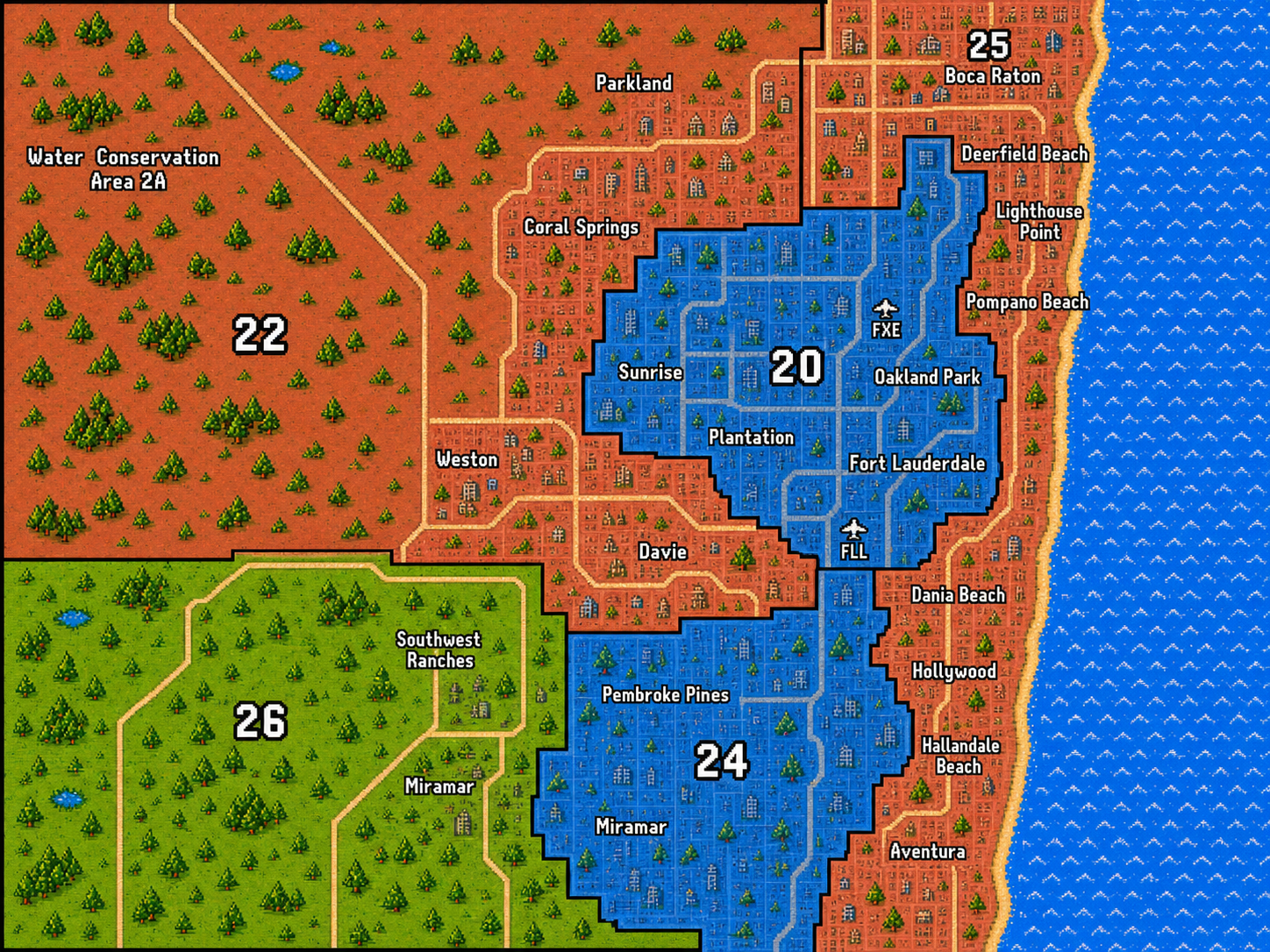
The new congressional maps passed by the legislature this week highlight the fatal flaw in the Florida Democrats redistricting strategy when lawmakers packed 44,000 white voters into District 20. That move severely weakens the voting power of the Black American and Caribbean American voters the seat was originally drawn to protect.
The immediate reaction from some will be to launch a political brawl over who gets to “own” the seat. Perennial candidate Elijah Manley already framed the issue that way, arguing that a non-Black candidate running in a historically Black seat would contribute to the dismantling of Black representation.
That argument is emotionally understandable. But strategically, it's too small.
This moment requires more than defending the old boundaries. It requires proving that Black political leadership can lead a broader district, not just inherit a protected one.
Right now, the Democratic Party operates as a coalition of silos with a winner takes all approach. Traditionally, the winner of a seat like this will represent their specific community first.
To paraphrase District 20 candidate Luther Campbell, Whether the candidate is “chinese, black, green, purple, jew,” they naturally champion their own base. They don't necessarily do this to the exclusion of other Democrats in the coalition, but the structure creates inherent friction.
THAT'S THE WRONG FIGHT
Black leadership should not approach this moment from a position of fear. It should approach it from a position of strength.
District 20 is changing. That's the reality. But change does not automatically mean loss. It means leadership has to adapt. The answer to 44,000 new white voters isn't to retreat into a smaller, racial argument. It's to bring those voters into a broader coalition led by the communities this district was created to protect.
That does not make the district “whiter.” It makes the representation broader. It asks Black leaders to do what strong leaders have always done: build majorities, expand influence and force every candidate to compete for their support.
The old model treated minority access seats like political bunkers. Hold the seat. Protect the seat. Fight anyone who enters the seat.
But politics is additive. Coalitions are power. To win and actually get results, you need to bring groups together.
The concept of an 'access seat' runs completely contrary to that fundamental rule. These protected districts reinforce those political silos. They guarantee minority communities token representation, but they actively deny those same communities a real seat at the table where the actual decisions are made.
A REAL SEAT AT THE TABLE
A real seat at the table means being an important part of a broader, winning coalition. It means your support is never taken for granted. If you walk away, it puts that elected official right out of a job. Shrewd local black elected officials have figured this out - if you're the swing voter, you're the real decisionmaker in your city.
The political landscape is shifting dramatically in Florida and Republicans are actively working to build their own diverse coalitions. You may even find that the GOP is your best ally. With Byron Donalds at the top of the ticket this year, the party is making a direct play for the very voters District 20 represents. When both parties are forced to compete for your support, you stop being a captive audience and become a kingmaker.
That presents the perfect opportunity to expand your influence.
BUILD THE COALITION
Black leaders can fight over a shrinking piece of an isolated pie, or they can use the new demographics to build a larger coalition. They can treat 44,000 new white voters as a threat, or they can bring them into a districtwide majority rooted in the Black and Caribbean American communities.
That is power.
If you can't beat the current political reality, you have to use it. Stop settling for a guaranteed seat in the corner. Build the coalition and compete for the vote.